

Most people have heard of impacted wisdom teeth. Fewer realize that impaction can affect other teeth too, that some impacted teeth cause no symptoms at all while others lead to serious complications, and that the decision between removal, monitoring, and other treatment options depends on more than just whether the tooth hurts. Understanding what an impacted tooth is, how it is evaluated, and how treatment decisions are made helps you approach the situation with clarity.
What Is an Impacted Tooth?
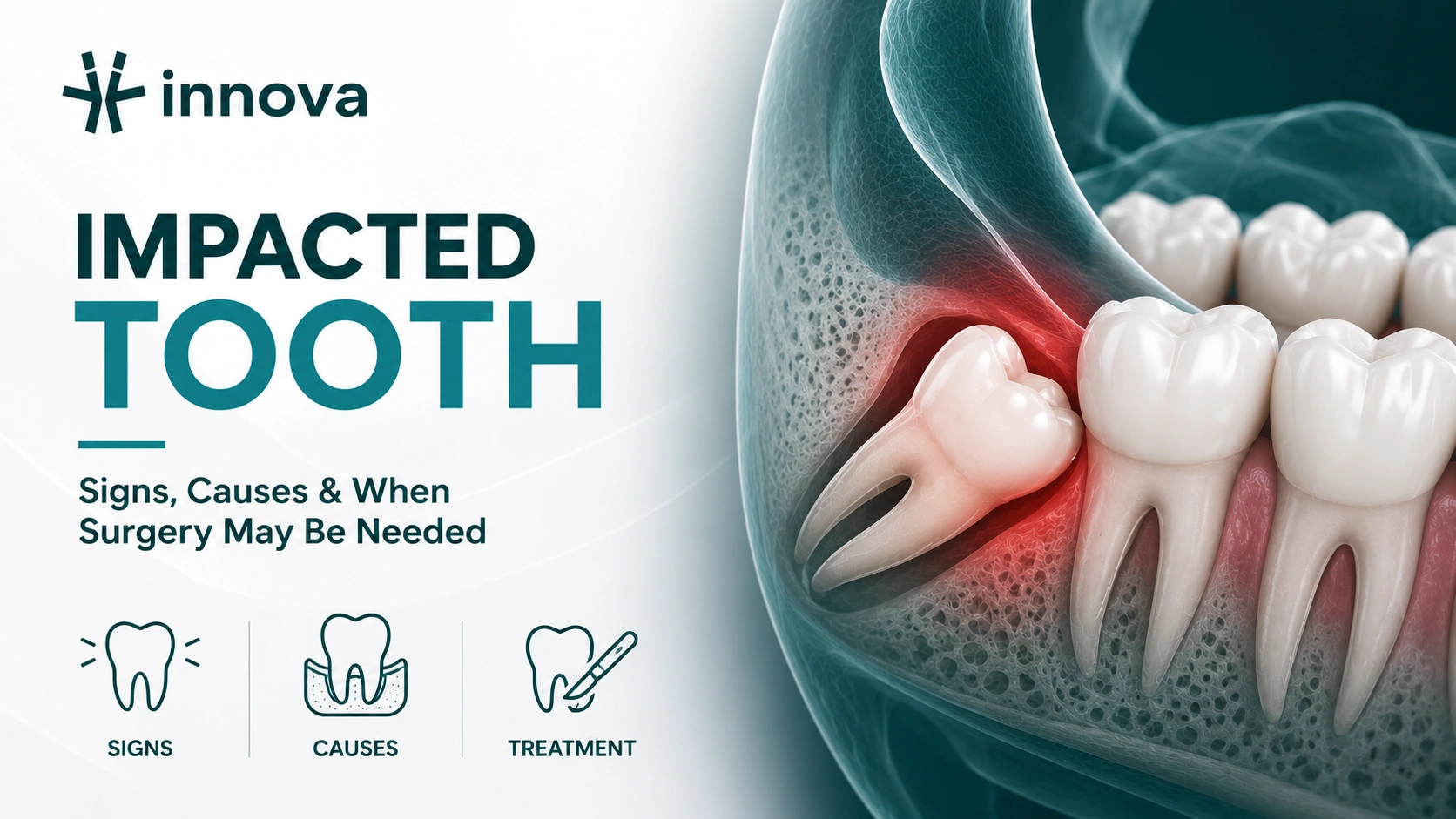
An impacted tooth is a tooth that cannot fully erupt through the gum line. Instead of growing into its proper position in the dental arch, it becomes stuck, either partially or completely, within the gum tissue or the jawbone.
Impaction most commonly affects wisdom teeth, which are the last teeth to develop and frequently lack adequate space to erupt properly. It can also affect canines, the pointed teeth just outside the four front teeth, and in less common cases, premolars or other teeth.
There are three general impaction types based on how much of the tooth has erupted:
Soft tissue impaction occurs when the tooth has pushed through the jawbone but has not broken through the gum tissue above it.
Partial bony impaction occurs when part of the tooth has emerged through the bone but remains partially trapped. In some cases, part of the crown is visible above the gum line. In others, nothing is visible at all.
Full bony impaction occurs when the tooth remains entirely within the jawbone with no eruption through bone or gum tissue.
The impaction type, combined with the tooth’s angle and its proximity to surrounding structures like nerves and adjacent roots, guides how an oral surgeon approaches evaluation and treatment.
How Do You Know If a Tooth Is Impacted?
Some impacted teeth cause noticeable symptoms. Others are discovered only during a routine dental exam through X-rays. An impacted tooth that is not yet causing pain can still be causing structural damage beneath the surface, which is one reason regular checkups matter.
When symptoms do occur, they may include:
- Pain or tenderness in the jaw, particularly toward the back of the mouth
- Swollen, red, or bleeding gum tissue near the affected area
- Persistent bad taste or bad breath caused by bacteria collecting around a partially erupted tooth
- Difficulty opening the mouth fully, or discomfort when chewing
- Headaches or earaches that appear to radiate from the jaw
- A visible gap where a tooth should have erupted, or a shifting of neighboring teeth
Symptoms may come and go rather than being constant. Pressure against neighboring roots, early cyst formation, and bone changes can all occur without obvious pain in the early stages.
Why Do Teeth Become Impacted?
The most common underlying reason is a lack of space. When the jaw does not have enough room for a tooth to erupt along its intended path, the tooth becomes blocked. Several factors contribute to this:
Jaw size relative to tooth size. A smaller jaw with normal-sized teeth creates crowding that limits eruption space. This tends to be inherited.
Eruption angle. Some teeth develop at an angle that puts them on a collision course with adjacent teeth or bone, preventing normal eruption regardless of available space.
Neighboring teeth or retained baby teeth. If a baby tooth does not fall out at the expected time, it can block the adult tooth trying to emerge beneath it. Adjacent permanent teeth can also obstruct an erupting tooth’s path.
Impacted Wisdom Teeth vs Impacted Canines: A Critical Difference
Most conversations about impacted teeth focus on wisdom teeth, but impacted canines are a separate situation that is handled very differently and where early identification makes a meaningful difference in outcomes.
Impacted wisdom teeth are the most common form of impaction. Because they are the last teeth to develop, they frequently encounter a jaw with no remaining space. When impacted wisdom teeth are causing pain, infection, damage to neighboring teeth, or cyst formation, removal is usually recommended. When they are not causing symptoms or visible structural damage, monitoring with regular imaging is sometimes appropriate.
Impacted canines require a fundamentally different approach because canines are essential to bite function and the structural stability of the dental arch. When a canine is impacted, the goal is typically not removal. The standard approach involves surgical exposure of the tooth followed by orthodontic guidance to bring it into its correct position over time. This requires coordination between an oral surgeon and an orthodontist, and it works best when identified before significant root development has been completed.
Understanding which tooth is impacted, and what role it plays in the bite and arch, is central to how the treatment decision is made.
Can an Impacted Tooth Be Left Alone?
This is one of the most common questions patients ask, and the answer depends on the specific tooth and what imaging shows.
Some impacted teeth, particularly those fully contained within the bone, not causing symptoms, and showing no sign of damage to neighboring structures, can be monitored over time. This approach may be appropriate when surgical risks outweigh the current risk of the tooth remaining in place.
Monitoring is not the same as ignoring. It requires regular imaging to confirm the tooth is not shifting, not creating pressure on neighboring roots, and not developing a cyst. The decision to monitor rather than treat is an active clinical judgment that needs to be revisited at each follow-up, not a permanent conclusion.
When Is Oral Surgery Needed for an Impacted Tooth?
Oral surgery becomes necessary when the impacted tooth is causing or is likely to cause harm that monitoring cannot prevent. The factors an oral surgeon weighs include:
Infection. Pericoronitis is an infection of the gum tissue that develops around a partially erupted tooth when bacteria collect in the pocket between the gum and the exposed crown. Recurring pericoronitis does not resolve permanently with antibiotics alone. Addressing the source is required to stop the cycle.
Damage to neighboring teeth. When an impacted tooth presses against the roots of adjacent teeth, it can cause root resorption, a process where the root structure of the neighboring tooth begins to deteriorate. If significant, this can compromise or ultimately lead to the loss of that neighboring tooth.
Cyst formation. Every developing tooth sits within a small sac of tissue called a follicle. When a tooth becomes impacted, this follicle can fill with fluid and expand into a dentigerous cyst. Cysts can damage the surrounding jawbone and, in rare cases, develop into more serious lesions. Removing the impacted tooth addresses both the tooth and the cyst at the same time.
Orthodontic interference. An impacted tooth pushing other teeth out of alignment, or preventing orthodontic treatment from being completed, may need to be addressed surgically before or during that treatment.
Age and risk over time. In younger patients, the bone around an impacted wisdom tooth is less dense, roots are often not fully formed, and recovery tends to be faster. As patients age, surgical complexity and recovery time generally increase. This is why oral surgeons often recommend addressing impacted wisdom teeth in the late teens or early twenties rather than waiting for symptoms to appear.
How Oral Surgeons Evaluate Impacted Teeth
Evaluation begins with a clinical examination of symptoms, gum condition, and any visible signs of eruption or infection, followed by imaging.
For straightforward cases, standard dental X-rays provide an initial picture. For complex impactions, particularly lower wisdom teeth where the inferior alveolar nerve runs close to the roots, or impacted canines where precise positioning matters for surgical planning, CBCT imaging provides a three-dimensional view that standard X-rays cannot.
CBCT, or cone beam computed tomography, allows the surgeon to assess the exact position of the impacted tooth within the bone, its proximity to the nerve canal, the condition of neighboring roots, and whether any cyst development is present. This directly determines which surgical approach is safest and what sedation level is appropriate. In-house CBCT imaging at the time of consultation means patients do not need to travel elsewhere for diagnostic scans before a complete evaluation is done.
Treatment Options for Impacted Teeth
Depending on what the evaluation reveals, an oral surgeon may recommend one of several approaches.
Monitoring is appropriate for asymptomatic impacted teeth showing no signs of damage or disease progression, with regular imaging to confirm stability over time.
Surgical extraction is the standard approach for impacted wisdom teeth that are causing problems or present meaningful long-term risk. The procedure involves a small incision in the gum tissue, removal of overlying bone if needed, sectioning of the tooth when the anatomy requires it, and suturing after removal. Most patients see the most significant swelling and soreness in the first three days, with soft tissue healing within two to four weeks.
Surgical exposure with orthodontic traction is the standard approach for impacted canines where preservation is the goal. The surgeon exposes the crown of the impacted tooth and bonds a small bracket to it. The orthodontist then applies gradual pressure over months to guide the tooth into its correct position in the arch. This is most effective when started before root development is complete.
Space creation is used in younger patients where imaging identifies a developing impaction that can still be avoided. Creating adequate room through orthodontic appliances may allow the tooth to erupt on its own.
What to Expect During and After Impacted Tooth Surgery
The procedure is performed with anesthesia, so there is no pain during surgery. Most cases take between 20 and 60 minutes, depending on complexity and how many teeth are being addressed.
The first 48 to 72 hours involve the most swelling and soreness. Keeping the head elevated, applying ice to the outside of the jaw for the first 24 hours, avoiding vigorous rinsing or straw use for the first 48 hours, and eating soft foods for several days all support recovery. Prescribed medications should be taken as directed.
Bone healing takes longer than soft tissue and is assessed at follow-up appointments. Smoking slows healing significantly and raises the risk of dry socket, a complication that occurs when the blood clot at the surgical site is disrupted before the site has healed.
Frequently Asked Questions
What happens if an impacted tooth is left untreated? Some remain stable for years. Others progress to cause infection, damage to neighboring roots, cyst formation, or crowding of surrounding teeth. An impacted tooth showing no symptoms now can still be causing structural changes that become more difficult to address later. Periodic imaging is the only way to confirm that a monitoring approach remains appropriate over time.
Will an impacted tooth resolve on its own? No. Once a tooth has become blocked from erupting, it will not find its path without intervention. If infection is present, it will not clear permanently without addressing the tooth itself.
How serious is an impacted tooth? It depends on the tooth, its position, and whether it is causing or likely to cause damage. A fully enclosed impacted wisdom tooth with no cyst formation and no pressure on neighboring roots carries different risk than one pressing against a second molar’s root or causing recurring infection. A proper evaluation with imaging is the only way to accurately assess the situation.
Is impacted tooth removal painful? The procedure is performed with anesthesia so no pain is felt during surgery. Post-operative soreness, swelling, and jaw stiffness are normal and typically peak in the first two to three days before improving steadily.
At what age should impacted teeth be evaluated? For wisdom teeth, the late teens to early twenties is generally the most favorable window. The bone is less dense, roots are often not yet fully formed, and recovery tends to be shorter. For canines and other teeth, identifying eruption concerns earlier allows for simpler intervention. A dental provider monitoring your child’s development will typically identify potential impaction issues through regular X-rays before symptoms appear.
Concerned About an Impacted Tooth?
If you have been told you have an impacted tooth, or you are experiencing jaw pain, gum swelling, or a gap where a tooth should have appeared, an evaluation with an oral surgeon is the right next step. At Innova Dental Implant Institute, Dr. Dexter Mattox is a board-certified Oral Surgeon and Implant Surgeon with dual DMD and MD training. Every treatment decision is built around what the imaging shows and what is right for that patient’s specific situation.
If you have questions about wisdom tooth removal or want to understand your options, a consultation is a straightforward place to start.