

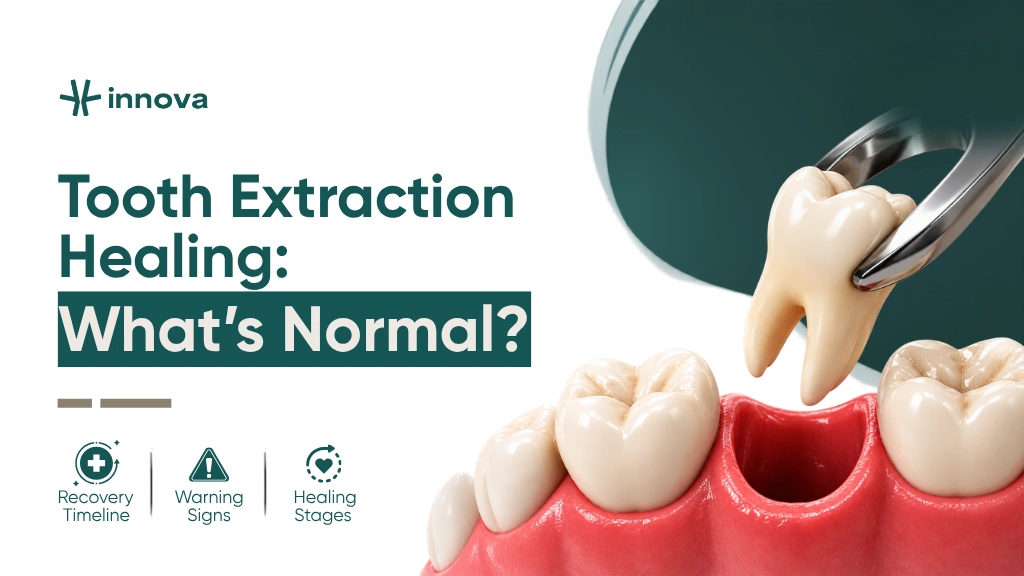
Tooth extraction healing follows a predictable sequence, but most patients do not know what that looks like until they are already in it. Knowing what each stage involves, how simple and surgical extractions differ, and when a symptom warrants attention makes recovery far less uncertain.
Simple extraction vs surgical extraction: healing is not the same
A simple extraction removes a fully visible tooth from the socket. Most patients feel significantly better within 48 to 72 hours and the gum closes within one to two weeks.
A surgical extraction is used for teeth that are broken at the gum line, have complex root anatomy, or are impacted beneath the bone, such as wisdom teeth. It involves a gum incision, possible bone removal, and tooth sectioning before removal. Discomfort peaks around days two to three and most patients feel substantially better within one week, though the socket continues closing over several weeks.
The type of extraction and the tooth involved directly affect healing time.
Tooth extraction healing: stage-by-stage timeline
Hours 1 to 24: Blood clot formation
A blood clot forms in the socket immediately after removal. It seals off the bone and nerve tissue and creates the scaffold new tissue grows across. Protecting it in the first 24 hours is the most important post-extraction step. Bite firmly on gauze for 30 to 45 minutes to control bleeding. Keep your head elevated the first night, apply ice to the outside of the jaw in 20-minute intervals, and avoid anything requiring suction. This is the period when the clot is most fragile, so avoid straws, spitting, and vigorous rinsing entirely.
Days 2 to 3: Swelling peaks
Swelling peaks on day two or three, not immediately after the procedure. Bruising may appear around the jaw or cheek. Ibuprofen (400 to 600mg every 6 to 8 hours with food) is generally more effective than acetaminophen alone because it addresses both pain and inflammation. Always follow your surgical provider’s specific guidance. After the first 24 hours, begin gentle warm saltwater rinses after meals.
Days 4 to 7: Granulation tissue forms
The blood clot is gradually replaced by granulation tissue, a soft pinkish-white material that forms a protective layer over the socket. Many patients mistake this for infection or food debris. It is not. Granulation tissue is healthy healing in progress and one of the most commonly misidentified signs of normal recovery. By the end of the first week, swelling and discomfort should be noticeably reduced.
Weeks 1 to 4: Gum tissue closes
Gum tissue closes over the socket within two to four weeks for simple extractions. For surgical extractions, particularly wisdom teeth, surface closure takes four to six weeks.
Months 2 to 6: Bone healing
Bone regeneration in the socket takes three to six months. This healing is not visible or symptomatic but is critical for anyone planning a dental implant. Patients who had a ridge preservation or bone grafting procedure at the time of extraction have a modified healing schedule that is monitored at follow-up visits.
What affects how quickly you heal
The tooth removed. Molars have multiple roots and larger sockets that take longer to close. Impacted wisdom teeth take the longest.
Age and health. Healing slows with age. Conditions like uncontrolled diabetes can extend recovery. Patients on blood thinners should flag this with their surgical team beforehand.
Smoking. Smoking reduces blood flow, inhibits clot formation, and significantly raises dry socket risk. Avoid it for at least 72 hours after extraction, and ideally longer.
Post-operative instructions. Avoiding straws, vigorous rinsing, spitting, and strenuous activity for the first 24 to 48 hours protects the clot and directly affects how quickly you heal.
Dry socket: causes, signs, and what to do
Dry socket occurs when the blood clot dislodges or dissolves before the socket heals, exposing bone and nerve tissue. It affects 2 to 5 percent of extractions and is more common after lower wisdom tooth removal.
Symptoms include sharp, throbbing pain starting two to four days after extraction, often radiating to the ear or temple, a visible empty socket, and a persistent bad taste or odor. Pain worsening rather than improving is the clearest warning sign.
Dry socket cannot be treated at home. It requires clinical treatment: gentle socket cleaning and placement of a medicated dressing that provides significant pain relief. To lower your risk, avoid straws, smoking, vaping, and forceful spitting for 72 hours. Avoid vigorous rinsing on day one.
Signs that warrant a call to your provider
Contact your provider if you notice any of the following:
- Pain worsening significantly after two to three days rather than improving
- Swelling spreading or increasing after day three
- Fever of 100.4 degrees Fahrenheit or higher
- Heavy bleeding not slowing with firm gauze pressure after 30 to 45 minutes
- Persistent foul taste or odor that does not improve
- Numbness or tingling not present when the anesthesia wore off
- Pus or discharge from the extraction site
If you are planning a dental implant after extraction
Most oral surgeons wait three to six months after extraction before placing an implant to allow adequate bone healing. Earlier placement is sometimes possible depending on bone condition and whether grafting was performed. Patients who had ridge preservation at the time of extraction preserve more bone volume, which can simplify future implant placement.
The wisdom tooth removal process and post-surgical care your oral surgeon provides play a direct role in how well the site is prepared for future treatment. When extractions and implant planning are handled by the same specialist, the treatment timeline is coordinated from the start rather than pieced together after the fact.
Frequently asked questions
How long does a tooth extraction take to heal? Soft tissue closes in one to four weeks depending on the type of extraction. Simple extractions typically close within two weeks. Surgical extractions, such as impacted wisdom teeth, take four to six weeks for surface closure. Bone healing takes three to six months regardless of extraction type.
How many days of rest are needed after a tooth extraction? Simple extractions allow return to light activity within 24 to 48 hours. Surgical extractions typically need two to three days of reduced activity, with avoidance of strenuous exercise for 48 to 72 hours.
What helps a tooth extraction heal faster? Protecting the blood clot is the most important factor. Avoid straws, spitting, and vigorous rinsing for the first 24 hours. Begin gentle warm saltwater rinses after that. Eat soft foods, avoid smoking, keep your head elevated the first night, and take medications as directed.
How do I know if my extraction site is healing normally? A healthy socket progresses from a dark red clot on day one to pinkish-white granulation tissue between days two and seven, then to closing gum tissue over the following weeks. Steadily reducing pain and swelling after day three, with no foul taste or odor, are all positive signs.
What is the white stuff in my extraction socket? White or yellowish-white tissue in the socket between days two and seven is almost always granulation tissue, healthy healing material replacing the clot. It is the most commonly misidentified sign of normal recovery. If accompanied by worsening pain, spreading swelling, or a foul taste, contact your provider.
How long does it take for the hole to close after tooth extraction? Simple extractions close at the surface within two to four weeks. Surgical extractions take four to six weeks for surface closure. The underlying bone continues filling in for three to six months after that.
How long does tooth extraction healing take with stitches? Dissolvable stitches dissolve within seven to ten days. Non-dissolvable stitches are removed within one week. Stitches do not significantly change the overall healing timeline.
How long does a molar extraction take to heal? Most patients feel substantially better within one to two weeks. Full surface closure of a molar socket takes three to four weeks. Bone healing takes three to six months.
When can I get a dental implant after tooth extraction? Most oral surgeons wait three to six months after extraction to allow adequate bone healing. Exact timing depends on bone condition, whether grafting was performed, and follow-up imaging findings.
Questions about your recovery
If something does not feel right after an extraction, or if tooth replacement is part of your plan, an oral surgeon gives you the most accurate picture of where you stand. At Innova Dental Implant Institute, Dr. Dexter Mattox is a board-certified Oral Surgeon and Implant Surgeon with dual DMD and MD training. Every patient receives thorough post-surgical follow-up and, when implant placement is part of the plan, a treatment timeline built around their specific healing and bone status.