

Dental implants are one of the most reliable and well-studied tooth replacement options available today. They are designed to last decades, and for the vast majority of patients, they do exactly that. Still, it is a fair question to ask: can an implant get infected? The answer is yes, it is possible. But with the right care, the right surgical team, and a clear understanding of what to watch for, infections are largely preventable and very treatable when caught early.
Here is a complete, honest look at the topic so you can move forward with confidence.
Implants Have an Excellent Track Record
Before getting into infections, it helps to put things in perspective. Dental implants have a long-term success rate of over 95 percent. They are placed in millions of patients every year and have become the gold standard for replacing missing teeth. Most people who get implants go on to enjoy them for the rest of their lives without any significant complications.
Understanding the low likelihood of infection is not a reason to worry. It is simply part of being an informed patient.
What Is Peri-Implantitis?
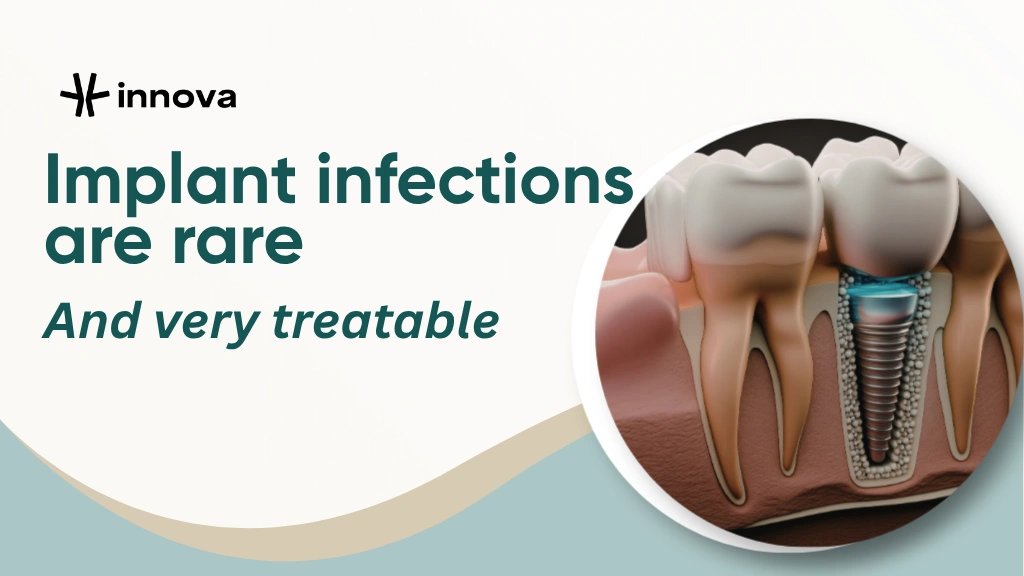
The infection associated with dental implants has a clinical name: peri-implantitis. It is an inflammatory condition that affects the gum tissue and bone surrounding an implant. It is not the same as a tooth infection. Because implants are made of titanium rather than natural tooth material, bacteria do not attack them directly. Instead, if bacteria build up around the implant site without being properly managed, they can cause inflammation in the surrounding tissue and bone.
The important thing to know is that peri-implantitis is not common, and it does not happen randomly. There are clear, identifiable risk factors, most of which are within a patient’s control.
What Raises the Risk?
Knowing what contributes to implant infections puts you in a strong position to prevent them.
Oral hygiene habits are the biggest factor. Bacteria build up around implants just as they do around natural teeth. Consistent brushing and flossing keep that bacterial load in check and protect the tissue around your implant.
Smoking affects how well gum tissue heals and how effectively the body manages bacteria. Patients who do not smoke tend to have significantly better long-term implant outcomes.
Blood sugar management matters for patients with diabetes. When blood sugar is well-controlled, the body heals efficiently and responds well to the implant. Many patients with diabetes go on to have completely successful implant outcomes with the right preparation and monitoring.
Immune health plays a role in how the body responds to any surgical procedure. Sharing a complete health history with your surgical team allows them to plan accordingly and give your implant the best possible start.
Gum disease history is something your surgical team will evaluate before any implant is placed. Addressing and stabilizing any existing gum disease before surgery is a standard part of responsible implant care, and it sets the foundation for long-term success.
Surgical environment and technique also matter enormously. Implant placement done in a proper surgical setting by a trained oral surgeon dramatically reduces the chance of complications from the start.
Signs to Watch For
Part of protecting your implant is knowing what healthy healing looks like and recognizing when something is worth mentioning to your care team. After surgery, some swelling and tenderness are completely normal and resolve within the first week or two.
Beyond the initial healing period, here are signs worth checking in about:
- Swelling or redness around the implant that does not settle down
- Bleeding when brushing near the implant
- Discomfort that lingers or comes back after healing is complete
- A persistent bad taste or odor near the implant
- Any sense that the implant feels different or less stable than before
None of these symptoms automatically mean something is seriously wrong. What they mean is that a quick evaluation will give you a clear picture. Early intervention, when needed, is straightforward and highly effective.
Treatment Options Are Effective
If peri-implantitis does develop, the good news is that there are strong, proven treatment options at every stage.
In the early stages, a professional cleaning of the implant surface combined with antibiotic treatment is often all that is needed to resolve the infection and protect the surrounding tissue.
For more advanced cases, minor surgical treatment can clean the affected area, support bone health, and restore stability to the implant site. Bone grafting techniques have become highly refined and can rebuild areas where some loss has occurred.
The key is catching changes early, which is exactly what regular follow-up appointments are designed to do. Your care team is your partner in keeping your implant healthy for the long term.
How to Keep Your Implant Healthy for Life
The steps that protect your implant are the same steps that support your overall oral health. None of them are complicated.
Brush and floss consistently. Your surgical team will walk you through the best technique for cleaning around your specific implant and restoration.
Keep your follow-up appointments. Routine check-ins allow your provider to monitor bone and tissue health and catch anything early.
Stay smoke-free. Patients who do not smoke consistently have the best long-term implant outcomes.
Manage your overall health. Conditions like diabetes that are well-controlled support excellent healing and long-term implant stability.
Communicate with your care team. If anything feels different or you have a question, ask. That relationship is one of the most valuable parts of your implant care.
The Surgeon Behind Your Implant Matters
One of the most important decisions you will make in your implant journey is who places your implant. Oral surgeons complete years of hospital-based surgical residency beyond dental school, with focused training in bone, tissue, anatomy, and complex reconstructive procedures.
At Innova Dental Implant Institute, Dr. Dexter Mattox is a board-certified Oral Surgeon with deep experience in implant placement, full-arch restoration, and complex surgical cases. Every patient is evaluated thoroughly, treated in a fully equipped surgical environment, and supported through every stage of the process.
That level of expertise is one of the strongest protections against complications from the start.
Ready to Learn More?
If you are exploring dental implants or have questions about an existing implant, the team at Innova Dental Implant Institute is happy to help. A conversation with our team is a good first step toward getting the clarity you need.
We serve patients in Brunswick, St. Simons Island, Jekyll Island, Jesup, Waycross, Hinesville, and the surrounding Southeast Georgia communities.