

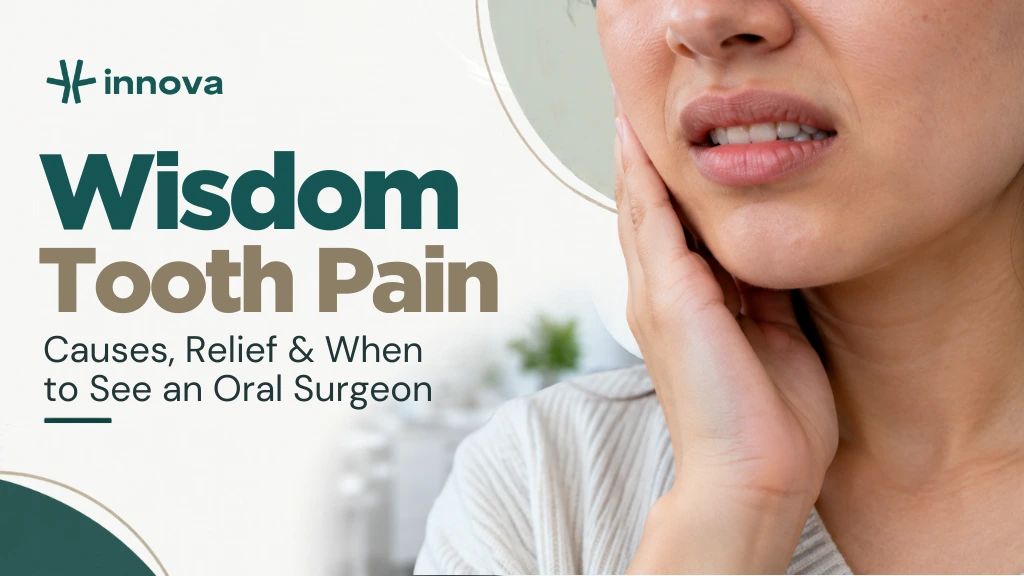
Wisdom tooth pain is one of the most common reasons people reach out to an oral surgery practice. The third molars, also called wisdom teeth, are the last teeth to develop and typically begin to emerge between ages 17 and 25. When there is not enough room in the jaw, they become impacted, partially erupt, or press against neighboring teeth, causing pain that ranges from a dull ache to sharp, recurring discomfort. In most cases, wisdom tooth pain is caused by eruption pressure, impaction, or infection of the surrounding gum tissue. Pain from a partially or fully impacted wisdom tooth does not resolve on its own. After removal, most patients find days two and three to be the most uncomfortable, with steady improvement from day four onward.
Understanding what is causing your pain, how long it is likely to last, and when it needs professional evaluation can help you make faster decisions and avoid complications that become harder to treat over time.
What causes wisdom tooth pain?
Wisdom tooth pain does not always come from the same source. Identifying the cause matters because the right response depends on it.
Eruption pressure is the most common cause of mild, early discomfort. As a wisdom tooth pushes through the gum tissue, the surrounding area becomes tender and sore. This type of pain tends to be dull and intermittent and may ease temporarily as the tooth moves.
Impaction occurs when a wisdom tooth lacks the space to erupt properly and becomes stuck partially or fully within the gum or bone. An impacted tooth may press against the roots of the adjacent second molar, create areas where food and bacteria become trapped, or contribute to bone loss over time. Impaction pain ranges from persistent dull pressure to sharp radiating pain that extends into the jaw, ear, or temple.
Pericoronitis is an infection of the gum tissue surrounding a partially erupted wisdom tooth. When a tooth only partially breaks through the gum, it creates a flap of tissue that traps food and bacteria underneath. The result is localized swelling, pain, a bad taste, and in some cases fever. Pericoronitis tends to recur until the underlying tooth is addressed.
Decay or damage to neighboring teeth can occur when an impacted wisdom tooth presses against the second molar. Over time, this pressure can damage the adjacent root, cause root resorption, or create an area where food is chronically trapped and leads to decay in an otherwise healthy tooth.
Cyst formation around an impacted tooth is less common but more serious. Each developing tooth sits within a follicle that can fill with fluid if the tooth fails to erupt. These cysts can expand within the jawbone and damage surrounding bone and teeth if not addressed.
Why does wisdom tooth pain come and go?
Wisdom tooth pain that cycles through periods of discomfort and apparent relief is typically caused by one of two things.
First, the body’s inflammatory response ebbs and flows. When a partially erupted wisdom tooth traps food and bacteria, the surrounding tissue becomes inflamed and painful. After a few days, the immune response temporarily reduces the inflammation and the pain decreases. The underlying issue has not resolved, but the acute episode subsides until the next cycle begins.
Second, the movement of an erupting tooth is not continuous. The tooth may push forward intermittently, causing pressure and pain during active movement and relative relief during pauses.
Pain that appears, improves on its own, and then returns is not a sign that the problem has resolved. In most cases it is a sign that the same cycle is likely to repeat.
How long does wisdom tooth pain last?
The answer depends on what is causing it.
Eruption pain from a tooth moving normally typically lasts 3 to 7 days during active eruption and should ease a little each day. It may recur in cycles as the tooth continues to emerge, but each episode should be less intense than the last.
Pain from an impacted tooth does not have a predictable endpoint without treatment. The underlying anatomy does not improve on its own. An impacted tooth that is causing pain is unlikely to stop doing so without an evaluation and treatment decision.
Pain from pericoronitis typically peaks within a few days of an infection episode, then decreases. Without addressing the tooth, the infection is likely to recur. Antibiotics may resolve an acute episode but do not address the source.
What to expect after wisdom tooth removal
Day 1: Anesthesia is still active and medication is at its most effective. Most patients find the first day manageable. Swelling begins developing but has not yet reached its peak.
Days 2 to 3: For most patients, this is the most uncomfortable period. The anesthesia has worn off, the body’s inflammatory response peaks, and swelling reaches its maximum. Jaw stiffness and mild bruising are common. This discomfort is expected and is not a sign that something has gone wrong.
Days 4 to 7: Swelling decreases and discomfort improves progressively. Most patients feel significantly better by day five.
Week 2 and beyond: Most discomfort resolves within the first week to ten days. Soft tissue continues healing through weeks two to four. Bone healing takes longer but is not typically associated with ongoing pain once the first week has passed.
Contact your oral surgeon if you notice: pain worsening after day three, swelling increasing after 48 to 72 hours, a fever above 101 degrees Fahrenheit, heavy bleeding that does not slow after 30 to 45 minutes of firm gauze pressure, a persistent foul taste or bad odor, or numbness that has not improved.
Dry socket is the most common post-extraction complication. It occurs when the blood clot is dislodged before the area has healed, leaving bone exposed. It produces sharp, throbbing pain beginning two to four days after surgery and requires treatment from your oral surgeon.
Temporary relief before your appointment
Ibuprofen is generally more effective than acetaminophen alone because it reduces both pain and inflammation. Follow the dosing instructions on the package label. Do not use ibuprofen if you have kidney issues, stomach ulcers, or take blood-thinning medication. If you are unsure which pain reliever is appropriate for you, ask your pharmacist before taking anything.
Warm saltwater rinses help reduce bacterial load around a partially erupted tooth. Dissolve half a teaspoon of salt in eight ounces of warm water and rinse gently three to four times a day.
Cold compresses applied to the outside of the jaw for 20 minutes on and 20 minutes off can reduce swelling and provide temporary relief.
Soft foods reduce irritation at the back of the mouth. Avoid anything small and crunchy that can work its way under the gum tissue around a partially erupted tooth.
These measures manage symptoms but do not address the underlying cause.
When to see an oral surgeon
Go to the emergency room or call 911 immediately if you have:
- Swelling that is spreading toward your neck or floor of the mouth
- Difficulty breathing, swallowing, or speaking
- High fever with severe facial swelling
See an oral surgeon promptly if you have:
- Pain, swelling, or redness that has persisted for more than 7 to 10 days or is getting worse instead of better
- Difficulty opening your mouth fully
- A fever alongside jaw or tooth pain
- Recurring pain that eases and then returns
- Been told your wisdom teeth are impacted
- Bad taste, bad breath, visible discharge, or pus near the back of your mouth
- Pain radiating into your ear, jaw, or temple
- Severe swelling in your face or cheek
Monitoring may be appropriate if a wisdom tooth is fully erupted, properly positioned, and causing only occasional mild discomfort, or an oral surgeon has already confirmed through imaging that monitoring is appropriate.
Monitoring is only appropriate when an oral surgeon has confirmed it based on imaging. Pain alone does not tell you whether an impacted tooth is affecting a neighboring root, developing a cyst, or contributing to bone loss. An X-ray or CBCT evaluation is needed to make that determination accurately.
At Innova Dental Implant Institute, wisdom tooth evaluations typically include in-house CBCT 3D imaging, which provides a three-dimensional view of the tooth’s position, its proximity to the inferior alveolar nerve, and the condition of surrounding bone and adjacent teeth. You can also learn more about wisdom tooth removal and what the procedure involves.
Frequently asked questions about wisdom tooth pain
How long does wisdom tooth pain last? It depends on the cause. Eruption pain from a properly moving tooth typically lasts 3 to 7 days and should ease each day. Pain from an impacted tooth or infection does not have a natural endpoint without treatment. Post-extraction pain is typically most intense on days two and three, with steady improvement from day four onward.
Why does wisdom tooth pain come and go? This pattern usually reflects a recurring cycle of bacterial accumulation and inflammation around a partially erupted tooth, or intermittent movement of an erupting tooth. Periods of relief do not mean the problem has resolved. The same cycle will keep repeating until the tooth is evaluated and treated.
What is the worst day after wisdom tooth removal? Most patients report days two and three as the most uncomfortable. This is when the inflammatory response peaks and swelling reaches its maximum. Pain and swelling typically improve steadily from day four onward.
What does wisdom tooth growing pain feel like? Wisdom tooth eruption pain usually feels like a dull, throbbing ache at the back of the jaw, sometimes spreading toward the ear or temple. The gum tissue around the tooth may feel tender or swollen. Some people notice jaw stiffness or a mild headache. If the pain is sharp, persistent, or accompanied by swelling, fever, or a bad taste, it is more likely infection or impaction than normal eruption.
Can wisdom tooth pain go away without removal? Pain from a fully erupted, properly positioned wisdom tooth may ease as the tooth settles. Pain from an impacted tooth, recurring infection, or damage to an adjacent tooth does not resolve without treatment. An oral surgeon can evaluate whether removal is necessary based on the tooth’s position and imaging.
How do I stop wisdom tooth pain quickly at home? Ibuprofen (follow the package label, if appropriate for you) is generally more effective than acetaminophen alone. Warm saltwater rinses three to four times a day and cold compresses on the outside of the jaw provide additional temporary relief. An oral surgery evaluation is the right next step when pain is recurring or persistent.
Do I need a referral to see an oral surgeon for wisdom teeth? No. Patients can contact an oral surgery practice directly without a prior referral.
Can impacted wisdom teeth cause ear pain or headaches? Yes. Upper wisdom teeth sit close to the maxillary sinus and can cause referred pain in the ear, temple, or head. Lower impacted wisdom teeth pressing against nerves can also cause radiating pain in the jaw and ear. These symptoms are sometimes mistaken for sinus problems or ear infections. An oral surgeon can determine through imaging whether the wisdom tooth is the contributing source.
What happens if impacted wisdom teeth are left untreated? Untreated impacted wisdom teeth carry ongoing risks including damage to the adjacent second molar, chronic infection through pericoronitis, and in some cases cyst development around the impacted tooth. The appropriate decision is made after imaging, not on the basis of pain alone.
Ready to get a clear answer about your wisdom tooth pain?
If you have been managing recurring pain at the back of your jaw, or you have been told your wisdom teeth are impacted, an evaluation gives you an accurate picture of what is happening and what your options are. At Innova Dental Implant Institute, Dr. Dexter Mattox is a board-certified Oral Surgeon and Implant Surgeon with dual DMD and MD training. Every evaluation includes in-house CBCT 3D imaging so the tooth’s position, nerve proximity, and effect on surrounding structures are assessed from complete diagnostic information before any plan is made.